
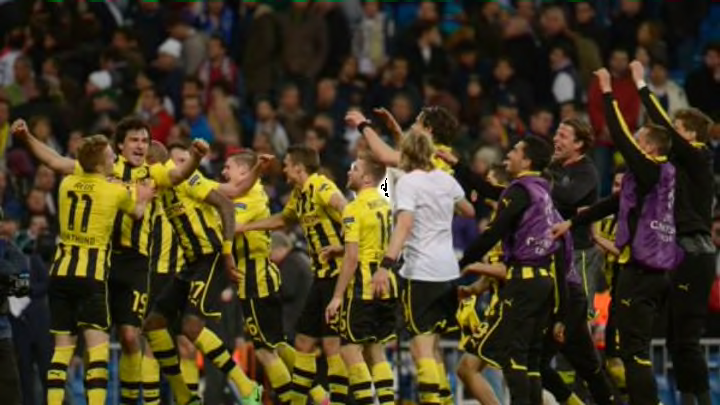
The 2012/13 Bundesliga campaign is fondly remembered as an era of unapologetic, hyper-vertical attacking football that completely shifted the paradigm of European goal-scoring expectations. Driven by innovative tactical frameworks like heavy metal counter-pressing and fluid winger combinations, multiple clubs abandoned conservative defensive shapes in favor of relentless forward numbers. For sports investors specializing in the total goals market, this specific seasonal ecosystem provided a remarkably fertile hunting ground. Finding sustainable success, however, meant analyzing which clubs combined explosive forward lines with defensive structural flaws, ensuring the match total consistently pushed past bookmaker projections.
Why the Top Attackers of This Era Outperformed Standard Models
Mainstream football modeling frequently fails to account for the compounding nature of momentum-driven offensive systems, creating a clear pricing lag in the wagering markets. When an elite German side during this cycle found its rhythm, their scoring output did not increase linearly; it exploded due to the sheer volume of high-turnover regains inside the opponent’s defensive third. Bookmakers struggled to adjust their totals lines quickly enough to mitigate the liability generated by these hyper-aggressive tactical systems.
This meant that even when a baseline match line sat at 3.0 or 3.5 goals, certain teams consistently possessed the tactical tools to comfortably clear the threshold. Sharp market participants recognized that raw historical averages were lagging indicators that failed to capture real-time offensive velocity. By focusing entirely on game-by-game structural match-ups, data-oriented backers repeatedly isolated scenarios where the over-market retained a massive statistical cushion.
Identifying the Most Explosive Entities in the Over Market
To structure a highly profitable selection framework, investors had to differentiate between teams that scored heavily while maintaining defensive control and those whose fixtures devolved into unscripted, high-scoring chaos. The latter category almost always yielded the highest long-term returns because both halves of the pitch contributed actively to the scoreline.
To visually map how these hyper-aggressive offensive philosophies directly translated into historic seasonal output, we can examine the structural divide between the league’s most potent attacking squads.
Every single team highlighted in this visual landscape operated with a distinct tactical formula that completely reshaped the betting lines. Bayern Munich relied on suffocating territorial dominance that wore opponents down through sheer volume of box entries, forcing high-scoring outcomes through individual brilliance and elite squad depth. Borussia Dortmund, conversely, operated as a high-speed transition machine that baited opponents into expansive possession before punishing them within seconds of a turnover. Understanding these mechanical variations allows a metrics-driven analyst to accurately project game flow instead of relying on basic, superficial league standings.
The Mathematical Breakdown of the Highest-Yielding Attacking Lineups
Evaluating the empirical evidence from this competitive cycle uncovers several prominent clubs that functioned as virtual guarantees for total goals backers. The data presented below isolates the critical metrics that drove these high-variance scoring trends across the 34-game season.
| Club | Total Attacking Goals | Clean Sheet Percentage | Match Total Exceeding 2.5 Goals | Average Match Goals (Combined) |
| Bayern Munich | 98 | 61.7% | 58.8% | 3.41 |
| Borussia Dortmund | 81 | 29.4% | 70.6% | 3.61 |
| Werder Bremen | 50 | 5.8% | 64.7% | 3.41 |
| Hoffenheim | 42 | 14.7% | 61.8% | 3.00 |
| Bayer Leverkusen | 65 | 26.5% | 58.8% | 3.11 |
Interpreting these specific numbers demonstrates why Borussia Dortmund was actually a far superior vehicle for high-scoring selections than the eventual champions, Bayern Munich. While Bayern scored more goals overall, their immaculate defensive structure often prevented opponents from scoring, which occasionally kept match totals lower than expected. Dortmund’s aggressive counter-pressing system, combined with a vastly more fragile backline, resulted in a staggering 70.6% of their matches breaching the Over 2.5 line, ensuring consistent payouts for total-market backers.
Tactical Triggers That Powered Dortmund’s Goal Deluge
Analyzing the specific on-pitch mechanisms behind Jürgen Klopp’s Borussia Dortmund squad reveals a tactical blueprint perfectly aligned with high-scoring betting profiles. The system prioritized extreme verticality, demanding that players look for an immediate forward pass the absolute second possession was recovered.
Conditional Scenarios in Transitional Vulnerability
When Dortmund squared off against mid-table opponents who possessed technical quality, the match inevitably transformed into an end-to-end track meet. Because Dortmund’s fullbacks pushed incredibly high up the pitch to support the attack, any failure in their initial press left their central defenders entirely exposed to rapid counter-attacks. This structural trade-off guaranteed that even if Dortmund dominated the scoreline, they were highly likely to concede at least once, providing an exceptional foundation for hitting the over-market.
The Flawed Brilliance of Thomas Schaaf’s Werder Bremen
For investors seeking maximum value away from the top-tier title contenders, Werder Bremen represented the absolute gold standard for high-variance betting. Thomas Schaaf maintained an unshakeable commitment to an expansive diamond midfield, an offensive strategy that completely disregarded defensive transition security.
This structural imbalance meant Bremen matches featured some of the highest collective shot volumes in modern European football history. Their matches averaged 3.41 goals because their attacking quality was constantly forced to overcompensate for a historically porous defensive line. Backers who consistently targeted Bremen’s fixtures for high-scoring outcomes achieved immense profitability because the market routinely underestimated just how easily their defensive shape would disintegrate under the slightest pressure.
Exploiting Dynamic Shift Rates via Live Market Tracking
Long-term survival in sports investment ยูฟ่าเบท moving past rigid pre-match predictions to understand how the live trading market reacts as a match progresses. Because German teams during this cycle rarely protected narrow leads, an early breakthrough often acted as a catalyst for an avalanche of subsequent goals.
When an early goal occurs, the trailing team is forced to abandon their defensive low block prematurely, creating massive gaps that high-octane attacking sides can easily exploit. Monitoring these live possession shifts enables analytical minds to strike when lines are momentarily mispriced by automated bookmaker software. Observing this fast-paced behavior allows a sports investor to operate with the same clinical accuracy as a seasoned statistician navigating probability streams across a premium online betting site, where success relies on exploiting real-time volatility rather than relying on stale historical baselines.
The Pitfalls of Backing Exhausted Offensive Formations
A critical failure point in an over-centric betting strategy occurs when an investor ignores the physical toll that high-intensity pressing styles place on mid-tier rosters. Clubs like Hannover 96 and Eintracht Frankfurt played spectacular, high-scoring football during the initial months of the season but suffered massive offensive drop-offs once injuries and fatigue accumulated.
When a high-pressing team loses its physical edge, their transition speed drops significantly, resulting in slower build-up play and a sharp decline in total match goals. Investors who blindly chased early-season goal trends without adjusting for squad depth or heavy fixture congestion suffered severe losses during the winter months. Recognizing this drop in physical output is absolutely vital to preventing unnecessary bankroll depletion.
Melding High-Probability Modeling with Elite Betting Platforms
To translate these historical data points into a functional, modern sports investment framework, an analyst must look past emotional fan narratives to focus entirely on mathematical edge. True value is captured only when a team’s real-world tactical probability of scoring or conceding outruns the implied probability built into the bookmaker’s price.
When a sharp data model identifies a clear mismatch between public narrative and actual tactical reality, executing that position with precision becomes a matter of platform choice. This strategic edge is optimized when sports enthusiasts utilize a modern sports betting service such as betting platform options like betting destination setups, ensuring that their high-yield positions are backed by maximum market liquidity and competitive odds lines. By treating every match as a cold calculation of probability, an investor insulates their capital from the natural variance of sport.
Summary
The 2012/13 Bundesliga campaign provided a masterclass in how to systematically identify and exploit high-scoring team profiles for maximum betting return. Borussia Dortmund and Werder Bremen served as the premier vehicles for the over-market because their aggressive, transition-heavy systems intentionally sacrificed defensive stability to maximize forward volume. Long-term profitability requires moving past basic point standings to evaluate these specific structural imbalances, avoiding fatigued squads during heavy fixture congestion, and utilizing live trading markets to capture mispriced lines during explosive game states. Ultimately, success relies on treating goal-scoring metrics as direct consequences of tactical systems, allowing disciplined backers to stay one step ahead of public consensus.
