
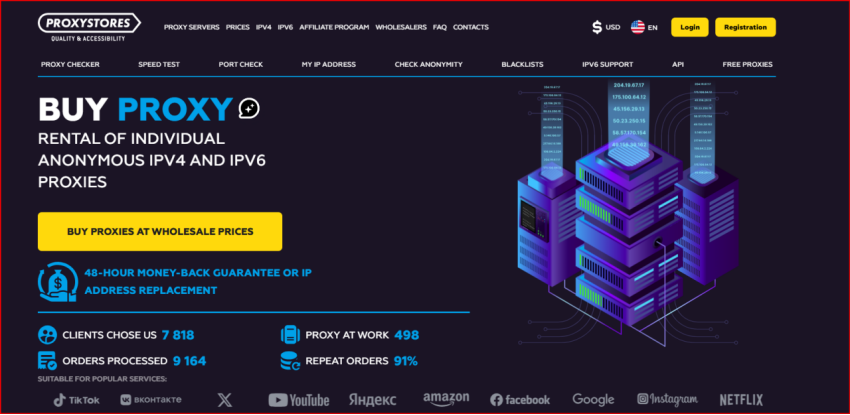
Provider link: ProxyStores official English website. Pricing and specifications in this review are a provider-published snapshot; confirm the live checkout before ordering.
ProxyStores website screenshot used as visual context for this review.
Before purchase, compare the live ProxyStores plans and order terms with the workload described below.
Start with the workload, not the feature list
ProxyStores sells several proxy types that can look interchangeable on a pricing page: shared IPv4, individual IPv4, IPv6 and MTProto, with common proxy protocols and checker tools around them. The better way to review the service is to map each feature to a real workload. A buyer doing SEO localization has different requirements from a buyer maintaining browser profiles, and both are different from a Telegram workflow. This review therefore asks a simple question: which ProxyStores product fits which job, and what trade-offs appear when you force a plan into the wrong use case?
I treat the provider’s published pricing, product labels and policy messages as the starting point, not as independent performance proof. I did not run a synthetic latency benchmark or a long-term uptime study. The practical value of a fixed proxy is destination-specific, so the final buying decision should come from a small pilot against the actual sites and applications involved.
Scenario 1: local SEO and regional SERP checks
For local SEO research, the first requirement is predictable geography. Individual IPv4 is the cleanest starting point because the address is dedicated to one customer for the rental term and can be assigned to one region or task. Shared IPv4 can be cheaper for broad, non-sensitive checks, but another customer’s activity can influence how search engines or websites perceive the address.
The workflow should verify more than the IP country. Check search language, currency, local results, consent screens and redirect behavior. If the project needs city-level precision, confirm that the exact inventory supports it. A country label alone does not guarantee that every result will match a user physically located in the target city.
Scenario 2: browser profiles and account-oriented workflows
Persistent browser profiles benefit from stability. Here I would favor individual IPv4 and keep one proxy mapped to one profile or one defined account group. SOCKS5 can be useful when the application needs broader TCP handling, while HTTP(S) is sufficient for many browser scenarios. The important part is consistency: do not swap an address between unrelated profiles simply because it is available.
A fixed proxy does not make a multi-account workflow safe by itself. Browser fingerprint consistency, cookies, device settings, authentication patterns and platform rules still matter. The proxy should be treated as one layer of identity separation, not as a guarantee against restrictions.
Scenario 3: public-data collection and market research
Public-data collection usually values cost, location coverage and predictable concurrency. Shared IPv4 can be a reasonable entry tier when the destination is tolerant and the data is public. Individual IPv4 becomes more attractive when blocks or session instability make shared addresses expensive in practice. IPv6 is worth testing when the target stack supports it because the published cost can be much lower.
For automation, I would add a health check before each batch. Confirm the proxy connects, verify the exit IP, test a neutral URL, then start the real collection job. Log failures by IP rather than retrying blindly. That gives the team evidence when deciding whether to replace an address or change request behavior.
Pricing snapshot: the same price can mean different value
The pricing table below uses the plan snapshot carried through the earlier review set. It highlights why price must be interpreted through the use case. A very cheap IPv6 block is excellent value when the destination supports it and poor value when it does not. An individual IPv4 address can look expensive beside shared IPv4 yet be cheaper overall if it reduces session problems or replacement work.
Rental duration should also match confidence. Five days is a pilot. Thirty days is a normal operating period. Longer terms reduce renewal overhead but increase the cost of being wrong. I would not jump to a 360-day order until the target sites, location and proxy type have been validated with the same software the team will use in production.
| Proxy type | 5 days | 30 days | 90 days | 360 days |
| IPv4 Shared | $0.67 | $0.99 | $2.97 | $11.88 |
| Individual IPv4 (1-20) | $0.96 | $1.77 | $5.31 | $21.24 |
| IPv6 /32 (1-99) | $0.10 | $0.51 | $1.53 | $6.12 |
| MTProto (1-20) | $0.96 | $1.77 | $5.31 | $21.24 |
Scenario 4: e-commerce localization and price verification
E-commerce testing needs location consistency more than raw throughput. A team may want to compare price, stock, shipping promises, tax display and currency across countries. Individual IPv4 is usually easier to audit because the address is not simultaneously being used by another customer. Shared IPv4 can still work for low-stakes catalog checks where occasional reputation variance is acceptable.
The proxy should be only one part of the localization test. Clear cookies between controlled test cases, record language and currency settings, and note whether the website uses account data or browser geolocation in addition to IP. Otherwise the team may blame the proxy for personalization that actually comes from cookies or the logged-in account.
Scenario 5: Telegram-compatible MTProto use
MTProto belongs in a narrow category: Telegram-compatible workflows that specifically use that protocol. It should not be treated as a general web proxy. Keeping MTProto inventory separate from normal HTTP/SOCKS5 inventory prevents configuration mistakes. The published pricing can resemble individual IPv4 pricing, but the technical purpose is different.
If the organization has both Telegram and browser workflows, label the credentials clearly. A good inventory system records protocol, assigned application, location, expiration and replacement history. That small discipline prevents operators from copying an endpoint into a tool that does not support it.
Feature-to-use-case decision map
Choose shared IPv4 when the task is cost-sensitive and can tolerate shared reputation. Choose individual IPv4 when exclusivity and stable assignment matter. Choose IPv6 when the destination and software explicitly support it and cost savings justify a separate compatibility lane. Choose MTProto only when the application requires it. Use HTTP(S) for ordinary browser/web workflows and SOCKS5 when broader protocol handling is useful.
The provider’s checker, speed test, anonymity test, blacklist tools and API are most valuable when embedded in a documented process. Tools do not replace judgment; they make judgment repeatable. A team that validates every new endpoint the same way will learn far more than a team that simply rotates through addresses until a target page loads.
Pros, limitations and buyer fit
The strongest aspect of ProxyStores is the simple product ladder: multiple fixed-proxy types, short rental terms and low entry prices. That works well for teams that know what they need and want to control the proxy lifecycle themselves. Limitations include workload-specific reputation, IPv6 compatibility differences and the fact that a fixed datacenter-style proxy is not the same product as a rotating residential network.
I would shortlist ProxyStores for SEO research, localization, market monitoring, browser profile workflows, public-data collection and compatible automation, provided the buyer tests the exact destinations. I would not buy a large pool solely because the unit price looks attractive.
FAQ
Which ProxyStores plan is the safest default? Individual IPv4 is the simplest default when compatibility and exclusive assignment matter more than the lowest possible price.
When should I try IPv6? When the destination list and internal software have been tested for IPv6 support. Run a small trial before making it a primary pool.
Are the checker tools enough to prove quality? They are useful diagnostics, but the real test is whether the proxy performs correctly with the exact destination and workflow you plan to use.
Final verdict
ProxyStores is easiest to evaluate when each product is tied to a job. The catalogue is flexible enough to cover several common proxy workloads, but flexibility creates responsibility: the buyer must choose the right IP type, protocol, region and rental term. Used that way, the service can be a cost-effective fixed-proxy option. Used as a one-size-fits-all pool, it is much harder to operate well.
Final check before buying: review the current ProxyStores product information and validate the exact location, term and configuration you plan to use.
