

Hiring is one of the most expensive decisions a small business makes, yet it is often handled in a rush. A key person quits, a big contract lands, or the owner finally admits they cannot do everything alone, and suddenly there is a job post online with a vague title and a long list of requirements. Applications trickle in, a few interviews happen in between other tasks, and someone gets hired mostly because the position needed filling yesterday.
Large companies have recruiting teams and formal processes. Small businesses rarely do, but they can borrow the same idea: treat hiring as a funnel. A funnel starts wide, with everyone who might see your opening, and narrows step by step until one person accepts an offer and settles into the role. The infographic below lays out seven stages of that funnel. The rest of this article explains what happens at each one, where small businesses commonly lose good candidates, and how to make each stage work better without adding bureaucracy.
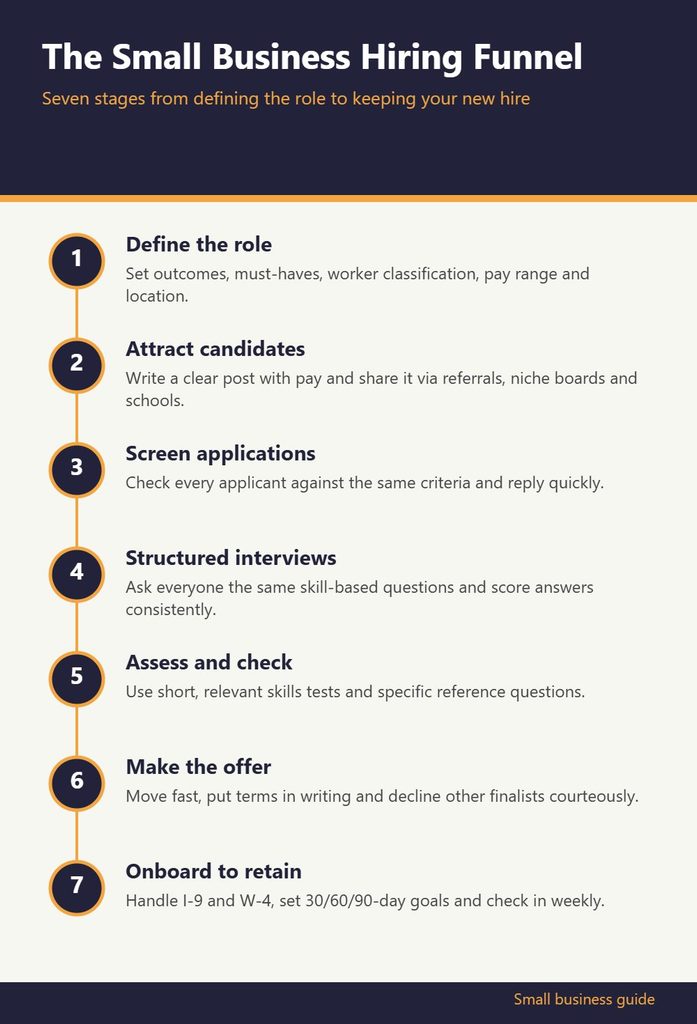
Stage 1: Define the Role Before You Advertise It
The funnel actually begins before anyone sees a job post. If you are not clear about what the role must accomplish, you cannot write a good advertisement, evaluate candidates fairly or explain to the new hire what success looks like.
Start with outcomes rather than tasks. Instead of “manage social media,” write “grow our Instagram following and drive inquiries to the booking page.” Then work backward to the skills and experience needed to deliver those outcomes. Separate the true must-haves from the nice-to-haves. Long requirement lists discourage capable people, particularly those who will not apply unless they meet every single point.
At this stage, also decide:
- Whether the role is full-time, part-time, contract or temporary.
- Whether the person will be an employee or an independent contractor. The classification depends on how the work is controlled, not just what you call it, and the rules differ at the federal and state level. Getting it wrong can lead to back taxes and penalties, so check with an accountant or employment attorney if you are unsure.
- The pay range you can realistically afford, based on what similar roles pay in your area.
- Where the work happens: on site, remote or hybrid.
Stage 2: Attract Candidates
The top of the funnel is about reach. You want the right people to know the job exists and to feel interested enough to apply.
Write a job post people want to read
A strong post opens with what makes the job and the business worth considering, then covers responsibilities, requirements, pay, schedule and location. Including a pay range is increasingly expected by candidates, and some states and cities now require it by law, so check the rules where you hire. Use plain language, avoid internal jargon and give a realistic picture of the job. A small business cannot outspend large employers on perks, but it can offer things candidates value: direct access to the owner, variety, flexibility, visible impact and a close-knit team.
Post in the right places
Large job boards provide volume, but they are not always the best source of fit. Consider:
- Referrals from current employees, customers and your professional network, which often produce strong candidates who already understand your culture.
- Industry-specific job boards and associations.
- Local community colleges, trade schools and university career centers.
- Your own website and social media channels.
- Local community groups and workforce development agencies, which may also offer hiring incentives or training support.
Track where each applicant came from. After a few hires, you will know which channels produce people who get hired and stay, and you can focus your effort there.
Stage 3: Screen Applications
Once applications arrive, the goal is to narrow the pool quickly and fairly. Create a short checklist based on the must-haves you defined in stage one, and review every application against the same criteria. This keeps decisions consistent and reduces the chance of being swayed by a polished resume that does not actually meet your needs.
For roles that attract many applicants, a few knockout questions on the application form can help, such as availability for required shifts or possession of a necessary license. An applicant tracking system can organize applications, but even a simple spreadsheet with consistent columns works well for a small business.
Respond promptly. Strong candidates often have multiple options, and a slow reply is one of the most common reasons small businesses lose them. A short message acknowledging receipt and explaining the timeline costs little and makes a good impression.
If you want templates and practical advice for this part of the process, GrowBizLab publishes guides on building a small team, from writing job posts to handling contracts and onboarding. If you are hiring for the first time, you can find out more there.
Stage 4: Interview With Structure
Unstructured interviews, where the conversation wanders wherever it goes, feel natural but tend to be poor predictors of job performance. They also make it hard to compare candidates fairly. A structured interview asks every candidate the same core questions, linked to the skills the role requires, and scores answers using a consistent scale.
A practical structure for small businesses:
- Short phone or video screen (15 to 20 minutes). Confirm basics such as pay expectations, availability and interest. Answer their questions about the role.
- Main interview (45 to 60 minutes). Use behavioral questions such as “Tell me about a time you handled an upset customer” and situational questions such as “What would you do if two clients needed urgent help at the same time?”
- Meet the team (optional). For roles with close collaboration, a short conversation with future coworkers helps both sides assess fit.
Take notes during or immediately after each interview. Memory fades quickly, and notes help you compare candidates on substance rather than vague impressions. Steer clear of questions about protected characteristics such as age, religion, marital status, pregnancy, disability or national origin. Employment discrimination laws apply to most employers, and some state laws cover very small businesses too.
Stage 5: Assess Skills and Check References
Interviews show how well someone talks about work. Skills assessments show how well they do it. For many roles, a short practical exercise is the most revealing part of the process: a writing sample for a content role, a mock customer email for a support role, a small coding task for a developer or a working shift for a trade position.
Keep assessments brief and relevant. Asking candidates to complete hours of unpaid work can drive good people away and may raise fairness concerns. If an assessment is substantial, consider paying for it.
Reference checks come next. Ask specific questions about the candidate’s work rather than general ones: “How did they handle tight deadlines?” or “Would you hire them again?” Background checks may be appropriate for some roles, but they must follow applicable federal and state rules, including disclosure and consent requirements. Some jurisdictions restrict when and how criminal history can be considered.
Stage 6: Make the Offer
When you find the right person, move quickly. Call to make a verbal offer, express genuine enthusiasm, and follow up promptly with a written offer letter. The letter should include the job title, start date, pay, schedule, key benefits, employment type and any conditions such as a background check.
Be prepared for negotiation. If you cannot increase salary, consider other levers: a signing bonus, extra paid time off, flexible hours, remote days, professional development or a scheduled pay review after a few months. Be honest about what you can offer. Overpromising to close a hire leads to disappointment and early turnover.
Once the offer is accepted, contact the other finalists courteously. A respectful rejection preserves your reputation and keeps the door open. The runner-up may be perfect for your next opening.
Stage 7: Onboard for Retention
The funnel does not end when someone signs. The first weeks on the job heavily influence whether a new hire stays and how quickly they become productive. Many early departures happen because the person never felt welcomed, trained or clear about expectations.
Before the first day, handle paperwork such as Form I-9 for employment eligibility verification and Form W-4 for tax withholding, enroll them in payroll and set up equipment and accounts. Then plan the first weeks:
- A clear schedule for day one, including introductions and a walk-through of how the business works.
- A written list of goals for the first 30, 60 and 90 days.
- A designated person to answer questions.
- Regular check-ins, weekly at first, to give feedback and catch problems early.
Ask new hires what could have gone better in their recruitment and onboarding. Their feedback is the best tool you have for improving the funnel. For more on setting up payroll, choosing HR software and organizing your first employee files, GrowBizLab has related guides worth bookmarking, so check it out when you are preparing for a new hire’s first day.
Measuring and Improving the Funnel
Even a small business can track a few simple numbers for each opening:
- How many people applied, and from which sources.
- How many reached each stage.
- How long each stage took.
- Whether the hire was still with you, and performing well, after six months.
These numbers reveal where the funnel leaks. If many people apply but few pass screening, your job post may be attracting the wrong audience. If candidates drop out between interview and offer, your process may be too slow or your pay out of line with the market. If hires leave within months, look closely at the role definition and onboarding.
Common Hiring Mistakes in Small Businesses
- Hiring a friend or relative without the same evaluation you would apply to anyone else.
- Copying a big company’s job description that does not reflect the actual role.
- Letting the process drag on for weeks while good candidates accept other offers.
- Relying on gut feel instead of consistent criteria.
- Treating onboarding as a single afternoon of paperwork.
A hiring funnel does not need to be complicated to be effective. Define the role, reach the right people, screen consistently, interview with structure, test real skills, make a clear offer and invest in the first few months. Done well, each hire becomes easier than the last, and your team grows with people who are capable, committed and ready to help the business thrive.
