
Background
Most people believe that water damage ends the moment the visible water is gone. A shop vac clears the floor, a few fans run overnight, and the assumption is that the house has returned to normal. That belief holds up in casual conversation, yet it rarely matches what happens inside walls, subfloors, and insulation after a pipe bursts or a storm floods a basement. Drying a structure is a process measured in days, not hours, and the visible surface tells only a small part of the story. Insurance adjusters often arrive days later to find damage far more extensive than the homeowner initially reported.
Moisture moves through building materials in ways that are easy to underestimate. Drywall wicks water upward from a soaked baseboard, wood flooring cups and swells long after the puddle is gone, and insulation can hold dampness for weeks without any outward sign. Humidity readings inside an affected room often stay elevated well after the carpet feels dry to the touch. Contractors who specialize in this work rely on moisture meters and thermal imaging precisely because human senses are unreliable indicators of how wet a structure actually is.
What the Research Shows
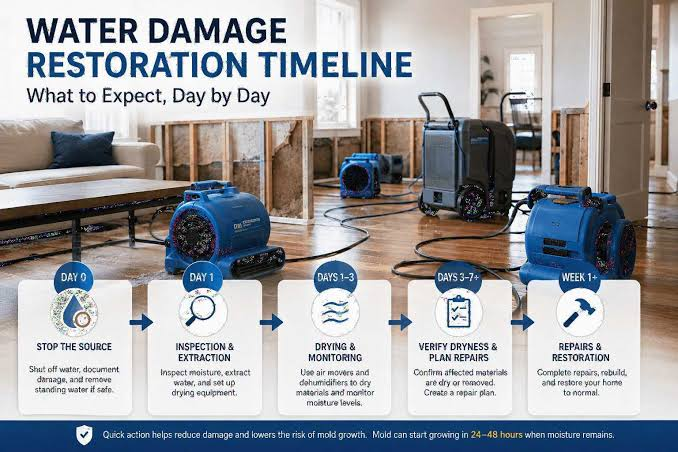
Studies on building material drying times consistently show that porous materials such as drywall and wood framing require sustained airflow and controlled humidity for seventy-two hours or longer before moisture levels return to a safe range. Mold researchers have documented spore growth beginning within twenty-four to forty-eight hours in warm, damp conditions, which is far sooner than most homeowners expect. This narrow window explains why response speed matters more than most people assume when a pipe fails or a roof leaks during a storm. Field studies conducted in humid climates show these timelines can shorten by a third once temperatures climb above eighty degrees.
Missouri’s humid summers and freeze-thaw winters add another layer of complexity, since ambient moisture in the air slows evaporation even when equipment is running correctly. Homeowners searching for emergency water damage restoration in Columbia MO often discover that the first few hours after a leak or flood determine whether materials can be saved or need replacement. Data from restoration companies operating in the region shows that structures treated within the first day have significantly lower rates of secondary mold growth and structural warping compared to those left untreated for forty-eight hours or more.
Beyond speed, the equipment used affects outcomes measurably. Industrial dehumidifiers paired with air movers positioned according to psychrometric calculations dry a space faster than consumer-grade fans, sometimes by a factor of three. Researchers studying drying efficiency have also found that removing wet carpet padding early, rather than attempting to dry it in place, shortens total restoration time and reduces the odds of odor retention. None of this is intuitive to someone dealing with a flooded basement for the first time, which is part of why professional assessment tends to outperform guesswork.
Practical Takeaways
Homeowners facing water intrusion benefit from acting within the first few hours rather than waiting to see how bad things look the next morning. Shutting off the water source, documenting damage with photos, and moving furniture off wet flooring are reasonable first steps anyone can take. Calling in professional help sooner rather than later tends to reduce total repair costs, since materials that stay saturated for days often need full replacement instead of drying and treatment. Waiting is rarely the cheaper option, even though it feels less disruptive in the moment. Keeping a written timeline of when water appeared and when help arrived also proves useful if an insurance claim becomes necessary.
Industry practice in this field follows IICRC restoration standards, which outline specific protocols for moisture measurement, drying verification, and contamination categorization that professionals use to determine when a space is genuinely safe again. Following those benchmarks rather than relying on visual inspection alone gives homeowners a clearer picture of when repairs are complete. A structure can look dry and still carry moisture readings above acceptable thresholds inside wall cavities, which is why documented verification matters more than a quick glance. Understanding this distinction helps homeowners ask better questions when hiring a restoration company and avoid paying for repairs on a structure that was never fully dried in the first place.
