
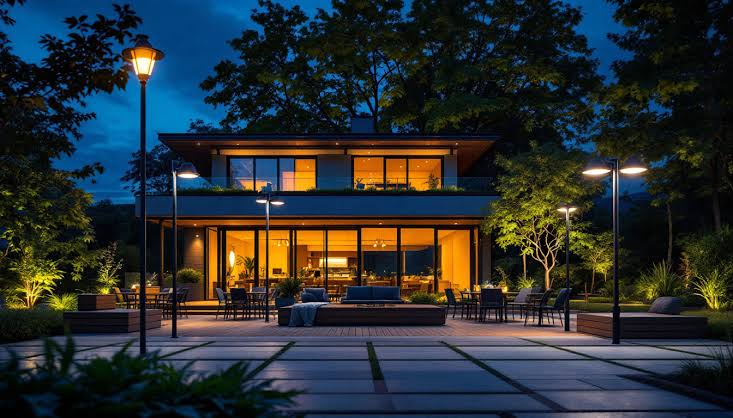
The Options
Homeowners who postpone exterior lighting decisions often end up with dark walkways, uneven security coverage, or fixtures that clash with their home’s style. Left unresolved, these issues cost money in emergency fixes and can even affect safety after dark. Getting the category right from the start saves both time and repeated purchases.
Exterior lighting generally falls into a handful of broad categories, each suited to different parts of a property. Wall-mounted sconces flank doorways and garages, offering a clean look with minimal wiring changes. Post lights work well along driveways or yard edges, marking where a property begins. Path lights sit low and guide foot traffic without overwhelming brightness, while floodlights cover larger areas that need security-level lighting. String lights and landscape spotlights round out the list, adding ambiance to patios or highlighting trees and architectural features.
Material choice adds another layer to the comparison. Aluminum and stainless steel resist rust near the coast, while cast brass develops a patina many homeowners like. Plastic composites cost less upfront but fade or crack sooner in freezing winters or intense summer sun. Bulb type matters too, since LED options now dominate the market for lower running costs and longer service life.
How to Evaluate
Comparing fixtures becomes easier once you separate function from appearance. A porch light chosen purely for looks might fail to cover the walkway leading up to it, while a floodlight selected only for brightness can wash out a facade that would otherwise look inviting at night. Reading a guide on choosing outdoor lights for your house before shopping helps frame these tradeoffs, since it lays out how coverage area, mounting height, and color temperature interact with a home’s layout. Skipping this step often means buying twice: once for the wrong fixture and again for the one that actually solves the problem.
Budget plays into evaluation as well, though the cheapest option rarely stays cheapest. Fixtures with sealed housings and weather-rated wiring cost more upfront but avoid the corrosion and bulb failures common in budget models. Warranty length is a useful shorthand here, since manufacturers who back a fixture for five or ten years generally trust the materials inside it. Comparing wattage and lumen output side by side, rather than trusting box art, keeps the evaluation grounded in what the light will actually do.
Placement testing before final installation catches problems that spec sheets miss. Temporarily clamping a fixture in place and observing it after dusk reveals glare, shadow gaps, or spillover onto a neighbor’s property that a diagram cannot predict. This kind of on-site check takes an evening but prevents drilled holes in the wrong location.
Making the Decision
Once the shortlist narrows to two or three finalists, energy use becomes a fair tiebreaker. Checking ENERGY STAR lighting guidance before finalizing a purchase clarifies which certified fixtures deliver the promised lumens without inflating a utility bill, since third-party verification tends to be more reliable than marketing claims alone. Fixtures carrying that certification also tend to hold their brightness longer, which matters for anyone who dislikes replacing bulbs every season.
Climate should factor into the final call as well. Homes in humid or coastal areas benefit from sealed, corrosion-resistant housings even at a higher price, while drier inland climates allow more flexibility in material choice. Anyone dealing with strict neighborhood covenants or historic district rules should confirm fixture styles are permitted before ordering, since returns on custom-finished lighting can be slow and costly.
The right combination of fixture type, material, and certification looks different for every property, though the decision gets easier once each factor is weighed against the others rather than judged alone. A short walk around the exterior at night, notepad in hand, often reveals more about actual lighting needs than any spec sheet. Taking that extra step before ordering tends to prevent the regret that comes from fixtures that looked right in a catalog but never quite worked outside.
