
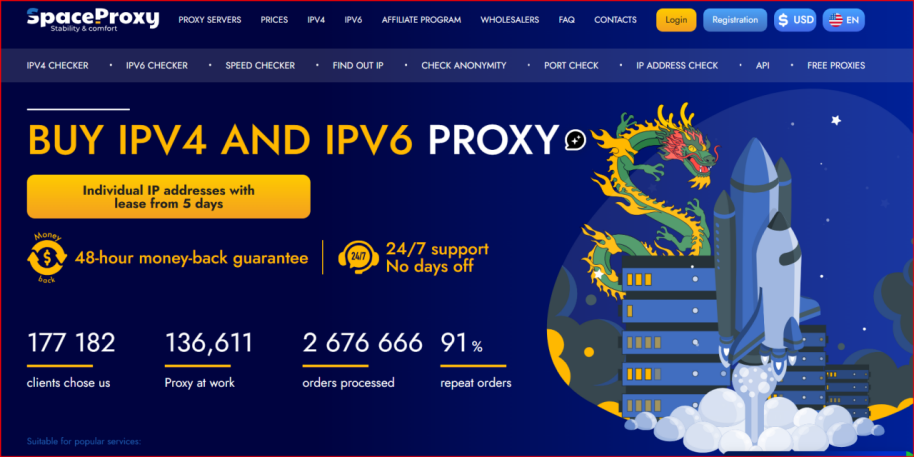
Provider link: SpaceProxy official English website. Pricing and specifications in this review are a provider-published snapshot; confirm the live checkout before ordering.
Before purchase, compare the live SpaceProxy plans and order terms with the workload described below.
Stage 1: the one-proxy trial
I approached SpaceProxy as a scale-up problem rather than a static feature list. The first stage is intentionally small: one proxy, one destination and one clear success condition. SpaceProxy publishes individual IPv4, shared IPv4, IPv6 and MTProto options, with HTTP/SOCKS5-oriented usage and utility tools such as proxy, speed, anonymity and port checking. At this stage, the goal is not to prove that the service can handle a giant operation. The goal is to verify that ordering, authentication, location and the target application all work together.
A one-proxy trial should answer basic questions quickly. Does the exit location match what was ordered? Does the browser or script connect without unusual configuration? Does the destination load consistently? Are login credentials easy to store? Can the proxy be checked independently before it is assigned to a production profile? If any of these answers is no, scaling would only magnify the problem.
Stage 2: moving from one proxy to a small working set
Once a single endpoint works, the next useful test is a small pool such as five to twenty addresses. This is where the difference between shared and individual IPv4 becomes operationally visible. Shared IPv4 lowers cost, but the team accepts that other customers can influence reputation. Individual IPv4 costs more, yet it creates a cleaner ownership model because each address is assigned to one customer for the rental period.
For a small team, I would assign one proxy to one purpose. For example, separate localization research, monitoring, browser profiles and automation. This prevents a good IP from becoming difficult to troubleshoot because several people are using it for unrelated tasks. A spreadsheet is enough at this stage: IP, type, country, assigned user or system, start date, expiration date and status.
Pricing: why rental duration changes the scaling equation
SpaceProxy’s published plan structure uses short and long rental periods. That is useful because it lets a buyer match commitment to confidence. A five-day order is a sensible validation tool. A 30-day order is easier for normal operations. Longer terms reduce the frequency of renewals but should be purchased only after the workflow is stable. The table below shows the pricing snapshot used for this review; live checkout should be treated as the final source because inventory, quantity and promotions can change.
The interesting scaling lesson is that price per IP is not the only cost. Longer commitments create renewal risk if the workflow changes. Short terms create administrative overhead. The best term is therefore the one that matches how predictable the project is. For a campaign with a fixed end date, a short rental may be ideal. For a stable monitoring system, a longer term can simplify operations.
| Proxy type | 5 days | 30 days | 90 days | 360 days |
| IPv4 Shared | $0.67 | $0.99 | $2.97 | $11.88 |
| Individual IPv4 (1-20) | $0.96 | $1.77 | $5.31 | $21.24 |
| IPv6 /32 (1-99) | $0.10 | $0.51 | $1.53 | $6.12 |
| MTProto (1-20) | $0.96 | $1.77 | $5.31 | $21.24 |
Stage 3: introducing tools and repeatable validation
At ten or twenty proxies, manual checking is still possible but starts to become tedious. SpaceProxy’s checker-oriented tools matter more here because the team needs a repeatable pre-flight routine. Before assigning an endpoint, confirm connectivity, IP, location and basic anonymity. Record failures instead of simply replacing addresses until something works. That record tells you whether the problem is isolated, country-specific, destination-specific or configuration-specific.
I would also standardize the application configuration. Use the same authentication style, protocol, DNS behavior and timeout policy across comparable tasks. If one operator uses HTTP and another uses SOCKS5 for the same workflow, troubleshooting becomes unnecessarily complicated. Consistency turns a pool of proxies into infrastructure rather than a collection of credentials.
Stage 4: what changes near 50-100 IPs
The moment the fleet approaches dozens of addresses, governance becomes the main challenge. The provider’s API and account-management features can help, but the buyer needs its own source of truth. A useful inventory includes order ID, proxy type, location, assigned workload, protocol, acquisition date, expiration date, replacement history and notes about destination compatibility.
Scaling also changes the economics of mistakes. Renewing ten unused proxies is annoying; renewing one hundred can become a budget problem. The team should review utilization before every renewal. Remove addresses that no longer have owners. Separate experimental pools from production pools. Keep replacement events visible so an automation job does not silently continue with stale credentials.
Where IPv6 and MTProto fit in the journey
IPv6 can be extremely inexpensive and is attractive when the destination supports it. I would not mix IPv6 into an existing IPv4 workflow without a compatibility test, because some sites, libraries and internal tools still assume IPv4 behavior. Treat IPv6 as a separate lane with its own validation checklist. If it works, the cost savings can be meaningful; if it does not, the low price is irrelevant.
MTProto is similarly specialized. It is not a general substitute for a standard proxy. It belongs in Telegram-compatible workflows where that protocol is explicitly required. A mature proxy inventory labels these endpoints clearly so they are not accidentally assigned to ordinary browser or scraping tasks.
Support, refund window and replacement discipline
SpaceProxy advertises round-the-clock support and a 48-hour money-back guarantee. Those are useful risk controls, but only when the buyer validates immediately. Do not spend the first two days planning the integration. Place a small order, test the exact target sites, and raise issues while the order is fresh. Save screenshots and error messages so support can see whether the problem is authentication, location, connectivity or destination blocking.
At larger scale, define when an address qualifies for replacement. A single failed request is not enough. Use a short sequence of checks: confirm local internet access, confirm proxy authentication, check the exit IP, test a neutral site, then test the target. That process avoids blaming the proxy for application or destination problems.
Who SpaceProxy fits best
SpaceProxy fits buyers who want inexpensive fixed proxies and are willing to manage them as a structured pool. It can work for localization, SEO checks, market research, public-data collection, ad verification, social workflows and compatible automation. The service is less attractive for buyers who expect a managed residential proxy network, automatic rotation semantics or a guarantee that every destination will accept every IP.
My scale-up conclusion is that the service becomes more useful as the buyer becomes more organized. One proxy tests compatibility. Ten proxies test the workflow. One hundred proxies test the team’s operational discipline. The provider can supply endpoints; the buyer still has to build the lifecycle around them.
FAQ
Can I start with five days? Yes. Short rental terms are one of the clearest ways to validate a location and destination before a longer commitment.
Are shared IPv4 proxies enough for serious work? Sometimes. They are appropriate when cost matters and exclusive IP reputation is not critical. Individual IPv4 is usually easier to reason about for persistent identities and account workflows.
Does the API remove the need for inventory tracking? No. An API can automate ordering and management, but the organization still needs to know why each proxy exists and who or what uses it.
Final verdict
SpaceProxy is strongest as a low-cost fixed-proxy supplier for buyers who scale deliberately. The pricing structure supports small pilots, the product range covers the common IPv4/IPv6 and MTProto cases, and the supporting tools help with validation. I would start with a tiny pool, document the lifecycle, standardize configuration and only then expand to the quantity the workload actually needs.
Final check before buying: review the current SpaceProxy product information and validate the exact location, term and configuration you plan to use.
