
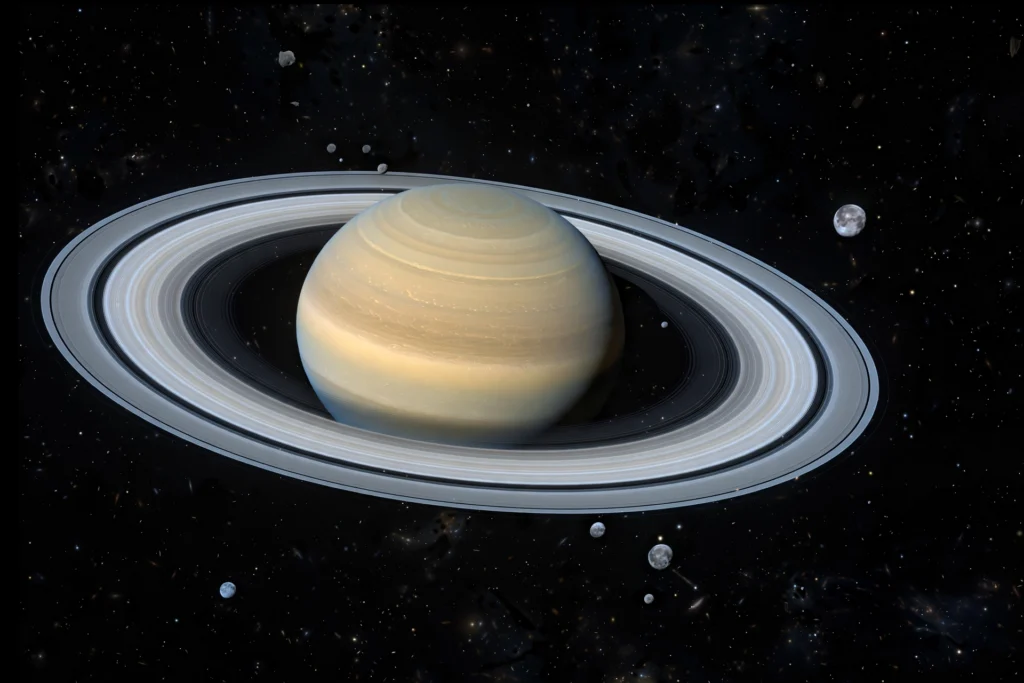
Every culture that watched the night sky gave Saturn a story, usually built around the one bright point they could see. The modern story is much larger. Astronomers have confirmed 128 new moons around Saturn, raising its total to 274 and giving it more moons than all the other planets combined. Behind that number lies a heritage of observation stretching from early telescopes to a mountain-top observatory in Hawaii and years of digital images waiting to be combined in just the right way.
The newly recognised moons are modest objects. Most measure only a few kilometres across and would look more like dark rubble than the round, bright Moon familiar from Earth. They orbit at great distances, frequently on paths that are tilted and sometimes retrograde, meaning they travel opposite to Saturn’s rotation. Their previous total was already 146, so the scale of the addition is striking: nearly as many moons again, identified not by a new spacecraft visit but by patient analysis from Earth.
An archive becomes a discovery
The survey relied on the Canada-France-Hawaii Telescope on Mauna Kea, with University of British Columbia researchers including Dr Edward Ashton contributing to the work, and formal recognition came from the International Astronomical Union. Details about the university’s research role can be followed through the University of British Columbia. The key point for readers is that discovery here was cumulative. Images gathered across several years held information that no single night’s observation could reveal on its own.
The method is called shift and stack. Astronomers take many deep exposures, shift them to keep pace with Saturn’s apparent motion and stack them so faint light accumulates. A tiny moon emerges as a point that moves consistently with the planet instead of behaving like a background star or a passing asteroid. Researchers then need enough observations to pin down an orbit. Heritage in science is often this unglamorous: preserving data, revisiting it with better software and checking a result until other experts can rely on it.
Families formed by break-up
Many irregular moons are thought to be chips from larger bodies. A captured moon, wandering in a distant and tilted orbit, could have been shattered by a collision, leaving fragments that still share clues in their paths. Grouping the new moons by orbit may therefore reveal families with a common ancestor. That is a satisfying idea for a site interested in ancestry: even in space, present-day objects can carry a traceable inheritance from an earlier generation that no longer exists intact.
The comparison has limits, of course. Moons do not pass down traditions, but their orbits do preserve history. A cluster of fragments can tell researchers roughly where a break-up happened and how the pieces drifted afterwards. Our article on whether brain games are effective approached a different kind of inheritance, the habits we hope will protect the mind, yet it rested on the same habit of asking what the evidence actually preserves. For Saturn, what is preserved is motion, and motion can be read backwards.
Why Saturn, and why now
Saturn is a favourable target because it is a giant planet with a huge gravitational reach, able to capture passing bodies and hold a wide retinue. It is also close enough, by outer-planet standards, for Earth-based telescopes to detect extremely faint companions when conditions and processing are right. Jupiter has a substantial family too, but Saturn’s distant irregular population appears especially numerous. The new survey exploited that opportunity by looking deeply and repeatedly at the region where small captured moons are expected to hide.
The timing reflects technology as much as geography. Digital detectors collect more light, computers handle large image sets, and algorithms can align frames with precision that would have been impractical for earlier generations. Mauna Kea still matters, because altitude and clear air improve the raw material, but the discovery belongs equally to the archive. In a way, the moons were photographed before they were discovered, sitting unnoticed in data until the team applied shift and stack with enough persistence.
A fuller family portrait
With 274 recognised moons, Saturn’s family portrait will need a very wide frame. Titan and a handful of other large moons will remain the names most people know, while the new arrivals may be identified by codes rather than evocative names for years. That does not diminish them. A complete census helps scientists understand how giant planets collect, destroy and rearrange material, and it sets a benchmark for future searches around other worlds. The planet in the evening sky has not changed. Our record of its household, built across generations of observers, finally has.
