
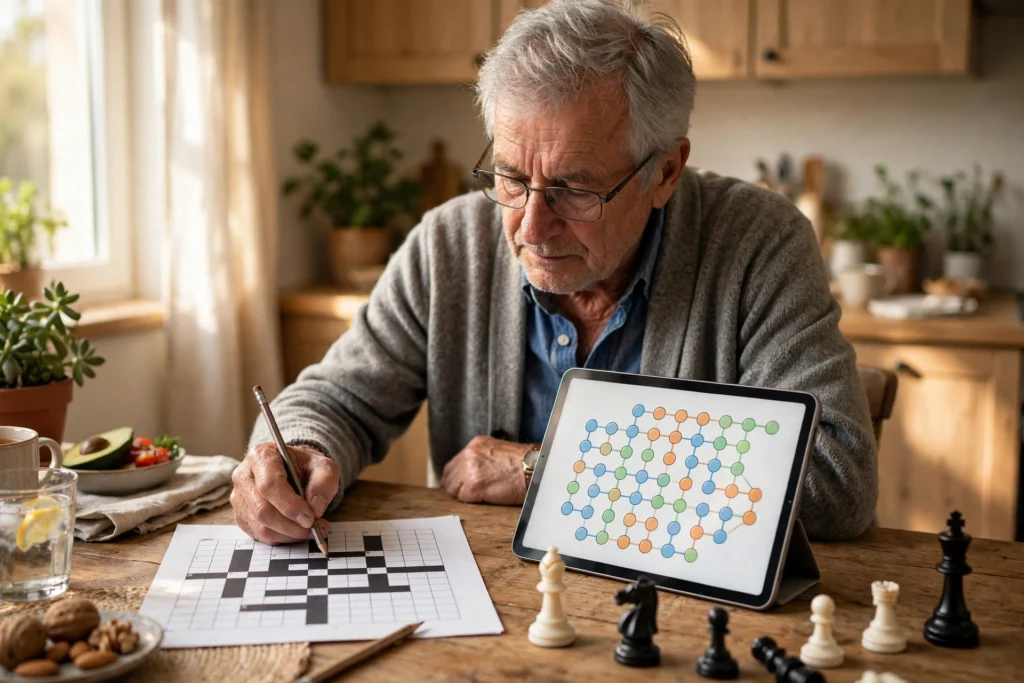
Brain-training apps are big business. With cheerful daily puzzles, streaks and scores that promise to keep your memory sharp and your mind young, they have attracted tens of millions of users — and no shortage of scepticism from scientists. So are brain games effective, or are they simply entertaining? The honest answer, supported by a growing body of research, sits somewhere in between: these games are very good at making you better at the games themselves, and much less proven at protecting your brain in everyday life.
What the research actually shows
The central question in brain-training research is “transfer” — whether practising one task improves abilities beyond that task. Study after study finds strong near transfer: play memory games and your game scores climb. Far transfer is weaker. Large reviews of the evidence have concluded that brain training does not reliably improve general intelligence, everyday memory or school and work performance, and regulators have acted on exaggerated claims — the makers of Lumosity were fined by the US Federal Trade Commission in 2016 for advertising benefits that were not supported by evidence. Tellingly, Lumosity’s own science pages now include a frank discussion of myths and facts about whether brain games are useless, acknowledging the limits of what puzzles alone can do.
That does not mean the research is entirely negative. The large ACTIVE trial in the United States, which followed older adults for a decade, found that a specific type of speed-of-processing training was associated with lasting benefits and, in later analysis, a lower risk of dementia. Some smaller studies also show modest gains for targeted training in people recovering from stroke or living with mild cognitive impairment, when programmes are supervised by clinicians. The pattern is consistent: focused training can help specific skills in specific groups, but a general “brain workout” app is not a shield against ageing or dementia.
Why the games feel so convincing
Brain games are designed to feel effective. Scores rise quickly at first — mostly because you are learning the rules and strategies of the game, not because your brain has fundamentally changed. Streaks, levels and leaderboards borrow the psychology of video games, keeping you returning daily. There is nothing wrong with that enjoyment; crosswords, chess, bridge and Sudoku have been loved for generations, often as part of family routines like the traditions some families only do on Sundays. The problem begins only when entertainment is sold as medicine.
What actually protects cognitive health
If apps are not the answer, what is? Researchers keep returning to the same unglamorous list. Regular physical exercise has the strongest evidence of any lifestyle factor for supporting brain health. Sleep matters, because the brain consolidates memories overnight. Managing blood pressure, hearing loss, diabetes and depression in midlife is associated with lower dementia risk later. Learning genuinely new skills — a language, an instrument, a craft — challenges the brain more broadly than repeating a familiar puzzle format. And staying socially engaged, whether through work, volunteering or family life, consistently appears protective. Harvard Health’s guidance on training your brain makes the same point: novelty, challenge and real-world complexity beat repetitive drills.
So should you delete the app?
Not necessarily. If you enjoy brain games, treat them as what they are: a pleasant pastime, closer to a crossword than to a vaccine. They are unlikely to harm you, they may keep you mentally active, and for some people the daily routine itself is valuable — much like the small daily habits involved in making a good decision when you are short on time, consistency counts. Just be wary of subscriptions sold on fear, and of any product that promises to prevent dementia.
The balanced verdict is this: brain games are effective at entertaining you and at improving the exact skills they practise. For lasting cognitive health, invest the same time and money in movement, sleep, learning and people. Your brain, like the rest of you, thrives on a varied life — not a single app.
