
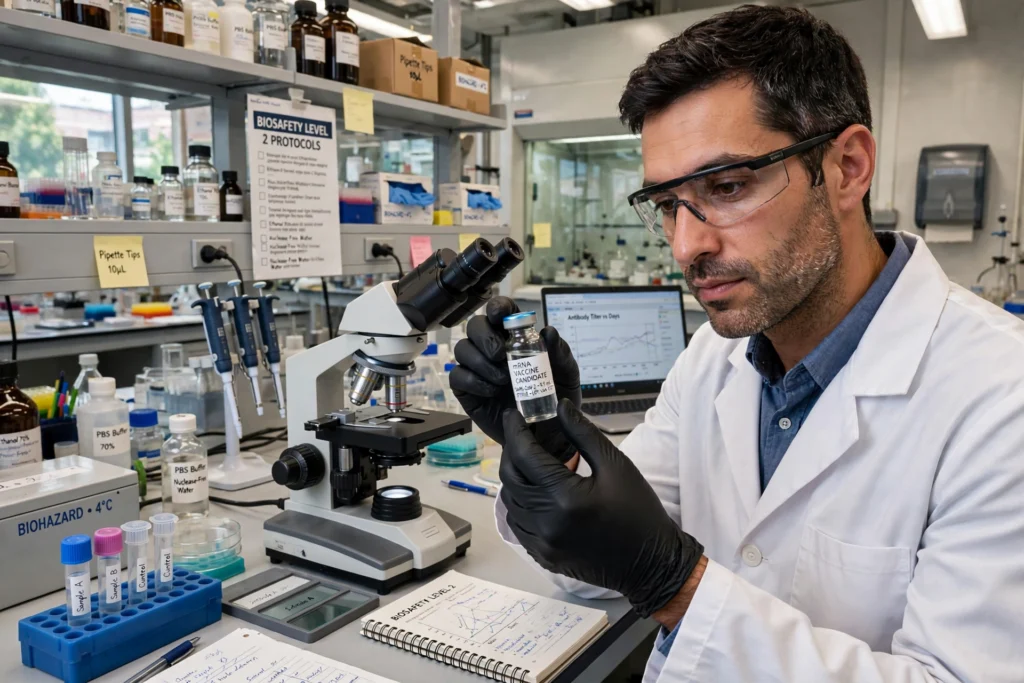
A personalised vaccine called NeoVax has completed an important early test in women with recurrent ovarian cancer, and the most responsible summary is a restrained one. In a phase 1 trial published in Nature Medicine, NeoVax was combined with nivolumab, a PD-1 checkpoint inhibitor. The vaccine, designed from each patient’s own tumour mutations, could be manufactured and administered. Safety was judged acceptable in this small study, and investigators observed immune responses. Nothing in the report turns that into proof of a cure.
The patients had platinum-sensitive recurrent ovarian cancer, meaning their disease had returned but had previously shown sensitivity to platinum-based chemotherapy. That is a difficult position for patients and families, because recurrence changes both treatment choices and expectations. A study in this group therefore attracts understandable hope. The task for reporting is to keep hope attached to what was actually measured: feasibility, tolerability and biological activity in an early trial that now needs larger and more rigorous follow-up.
One patient, one set of targets
NeoVax begins with the molecular story of an individual tumour. Mutations in cancer cells can create neoantigens, small abnormal protein pieces that differ from anything in healthy tissue. If the immune system can be shown those pieces in vaccine form, it may learn to identify cells displaying them. Selecting the targets is personal, time-consuming work. It links surgery or biopsy material, genetic analysis, vaccine design and manufacturing into a single chain that must hold together before treatment can begin.
Nivolumab is intended to support the other side of that interaction. By blocking PD-1, it interferes with a checkpoint that can dampen T-cell activity. The pairing is rational: present the immune system with tumour-specific flags, then reduce a braking signal that might limit the response. Information from Dana-Farber Cancer Institute, where personalised vaccine research has been a major theme, offers useful background on this field without replacing the trial paper itself.
Feasibility is a real result
It can sound anticlimactic to say that a treatment was feasible, but for a bespoke vaccine feasibility is foundational. If tumour material cannot be analysed in time, if manufacturing fails, or if patients cannot receive the planned doses alongside another drug, the concept stalls regardless of its elegance. This trial showed that those steps could be completed for enrolled patients in a research setting. It also reported immune responses, including T-cell responses, suggesting the vaccine strategy engaged the system it was designed to engage.
Engagement is not the same as benefit. A T cell can respond in a laboratory test while a tumour continues to grow for many reasons, including loss of the target, an inhospitable tumour environment or other immune escape routes. That is why later trials need clinical endpoints and comparison groups. A related caution appeared in our coverage of technology changing breast cancer detection: a promising tool must still be judged by outcomes in broad, well-designed studies, not only by whether it can detect a signal.
Safety, selection and scale
Acceptable safety in phase 1 deserves a precise reading. Participants are monitored intensively, eligibility rules exclude many higher-risk patients, and the sample is too small to reveal uncommon side effects. The finding means the combination could proceed to further study, not that it is suitable for routine use. Nivolumab itself can cause immune-related adverse effects, and adding a vaccine does not remove the need for specialist supervision. Families should be wary of any service offering a similar-sounding personalised vaccine outside a regulated trial on the strength of this publication.
Scale is the next barrier. A vaccine made for one person cannot be stockpiled like a standard medicine. Laboratories would need reliable turnaround, quality control and funding models if larger trials showed benefit. Researchers would also need to identify which biological features predict a stronger response, so that a complex intervention is offered where it has the best chance of helping. Those questions are less visible than the word vaccine, but they will determine whether this approach remains a specialist experiment or becomes a practical option.
What to take from the study
The fair conclusion is that NeoVax plus nivolumab passed an early feasibility and safety test in platinum-sensitive recurrent ovarian cancer, with signs that patients’ immune systems responded. That is worthwhile science, carefully framed by publication in Nature. It is not evidence that the vaccine cures ovarian cancer, prevents recurrence or improves survival. Larger studies are needed for those claims. Holding both truths at once, encouragement and restraint, respects the patients who volunteered and the readers who need information they can trust.
