
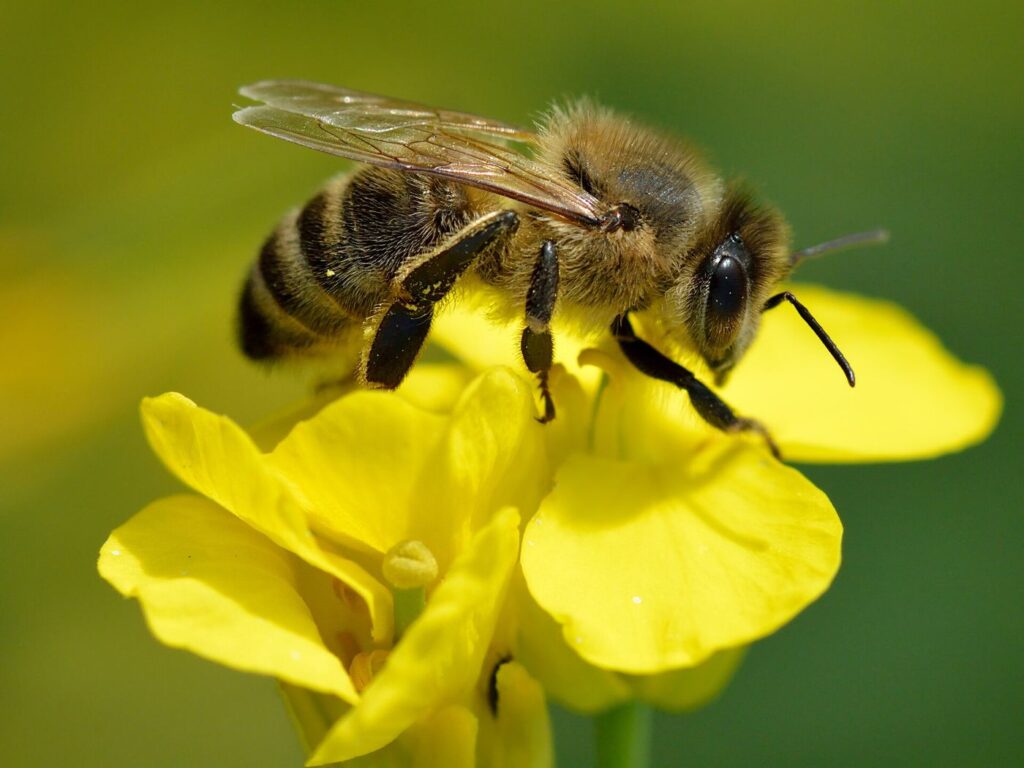
The world’s food depends on insects that most people barely notice. Bees pollinate roughly a third of the crops humans eat, from almonds and apples to coffee and cucumbers, and managed honey bees add at least 18 billion dollars a year to the value of American agriculture alone. That service is under strain. Between April 2024 and April 2025, American beekeepers lost an estimated 55.6 percent of their managed honey bee colonies, the highest annual loss since national tracking began in 2010, with winter losses alone reaching 40.2 percent. Commercial beekeepers, who move their hives across the country to pollinate crops, lost about 62 percent of their colonies, and the damage was estimated at more than 600 million dollars. The main culprit was the Varroa destructor mite, a parasite that weakens bees and spreads viruses, with mites resistant to the most widely used treatment found in nearly every sample examined.
What the Evidence Shows
The losses are not only a beekeeper’s problem. Wild bees, which pollinate many crops as effectively as honey bees, are also declining as meadows and wildflower habitats disappear under development and intensive farming. When pollinators falter, farmers face higher costs and lower yields, and the price of that reaches every shopper. The response is taking shape in several directions: researchers are breeding bees that resist mites, developing new treatments, and studying how diverse diets and habitats strengthen colonies. Farmers are planting wildflower strips and leaving field margins unmown, while gardeners are encouraged to grow native flowers and leave undisturbed ground for nesting bees. Honey bee numbers can be rebuilt by splitting surviving hives, but the wild pollinators that do much of the work cannot be replaced so easily. Protecting them is now a matter of food security. Reporting and analysis from sources such as Nature track the same developments, and specialists following bee colony losses say the direction is now consistent across independent lines of evidence.
The Wider Context
The wider context is a research landscape in which replication and open data now decide reputations. Findings connected to bee colony losses are being checked by independent groups with shared datasets, and the teams involved publish their methods in full so rivals can test every step. That discipline is slower than a headline cycle, but it is why results in this area increasingly survive first contact with scrutiny.
What Happens Next
What happens next in the story of bee colony losses will be decided by follow-up work already under way: larger samples, longer observation and instruments that have not yet come online. The researchers involved are unusually united on one point, that the current results justify the next investment of time and money. Readers will not have to wait long for the first tests of that claim. You can follow related developments in our coverage of science.
None of this will be settled by a single announcement, study or product launch. The pattern to watch is accumulation: independent confirmations, honest reporting of failures and steady improvement in the underlying numbers. Readers who follow those signals, rather than the loudest claim of the week, will understand this subject better than most of the commentary surrounding it suggests is possible.
